An International Sponsor Organisation (an "ISO") is organised as a non-profit legal entity when establishing an ECOSYSTEM which operates as a hybrid between traditional and digital implementations and as a core DAO ("dISO") when implemented as an ECOSYSTEM wholly within DIGITALUNIVERSE.
The PROTOCOL establishes a GOVERNANCE framework for the ECOSYSTEM, its Components, Operations and HUMAN, ORGANISATION and INTELLIGENCE participants.
The configurable section of the PROTOCOL involves its core objectives, procedures, components, etc.
In addition, it is useful to anticipate those requirements for operating wholly within DIGITALUNIVERSE or as a hybrid ECOSYSTEM.
It is of particular importance to include infrastructure to facilitate future operations which interact with various forms of INTELLIGENCEs.
An Ecosystem represents a digitally-centered operational model configured to achieve specific objectives. It combines traditional and digital infrastructures to create innovative, efficient, and sustainable operations. Ecosystems can range from standalone digital networks to hybrid models that integrate physical and digital frameworks, fostering transformative growth in both local and global contexts.
Core Features of an Ecosystem
1. Protocol-Driven Design:
• Defined by a Master Protocol, which provides the operational blueprint, including its Components, networks, inflows, and outflows.
• Embedded protocols ensure scalability and alignment with its objectives.
2. Hybrid Infrastructure:
• Operates as either:
• Fully digital within a network of computer nodes (e.g., DIGITALUNIVERSE), or
• A hybrid combining traditional physical infrastructure with advanced digital networks, including DigitalTwin(s).
3. Token-Based Value Systems:
• Uses digital tokens as currency or assets, which may be tradeable or redeemable.
• Incorporates Non-Fungible Tokens (NFTs) or value tokens to represent services, rights, or assets, including rewards points.
4. Integrated Relationships:
• Customers, suppliers, participants, and stakeholders may connect via:
• Decentralized Autonomous Organizations (DAOs).
• Peer-to-peer (P2P) networks.
• Traditional digital infrastructure.
5. Flexible Legal Entities:
• ISO (International Sponsor Organization): A series LLC or segregated portfolio company (SPC) that facilitates administrative services, ensuring compliance and transparency.
• dISO (Digital ISO): Operates exclusively in digital environments for decentralized ecosystems.
6. Collaboration Across Ecosystems:
• May facilitate linkages with affiliated Protocols or other Ecosystems to expand its reach and functionality.
Purpose and Benefits
• Operational Transformation:
Ecosystems enable the evolution of legacy business models through Digital Transformation (DX) and advanced AI.
• Value Representation:
Activities and assets within the Ecosystem may be represented as Controllable Electronic Records (CERs), offering secure, adaptable storage and conveyance of value.
• Scalability and Innovation:
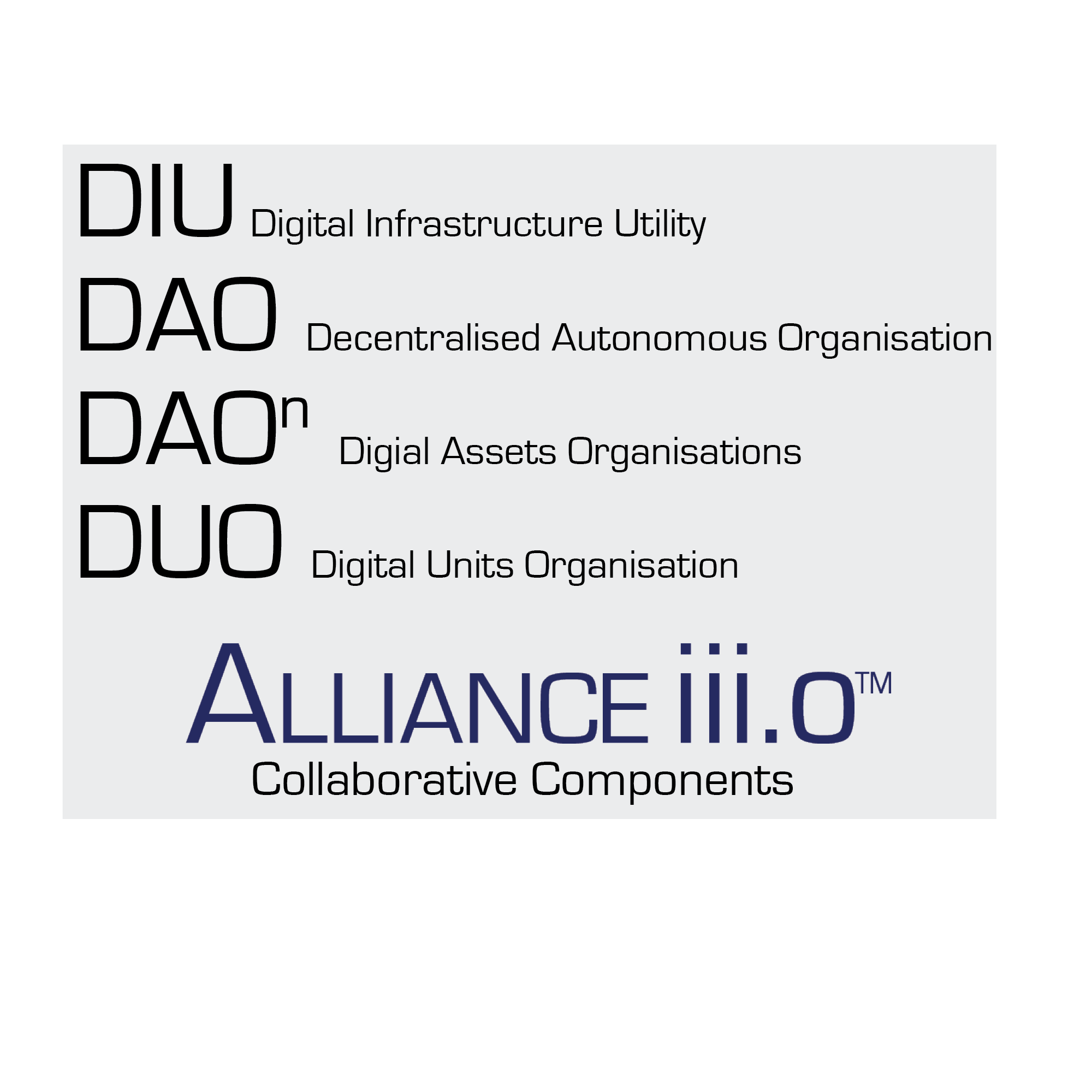
Leveraging digital infrastructure components such as Digital Infrastructure Utilities (DIUs), Digital Units Organizations (DUOs), and Digital Assets Organization Networks (DAOns) fosters modular growth.
Ecosystems Under Alliance iii.o Framework
The Alliance iii.o Framework empowers Ecosystems to implement modular, configurable structures supported by International Sponsor Organizations (ISOs). ISOs act as the nucleus, ensuring global compliance, sponsorship of projects, and facilitation of hybrid operations.
Visualizing the Ecosystem
1. Digital Representation: • Illustrates how computer nodes interconnect within DIGITALUNIVERSE to form an entirely digital Ecosystem.
2. Entity Integration:
• A schematic detailing the four primary entities—DIUs, DUOs, DAOns, and ISOs—and their interaction under a Master Protocol.
ISO and Ecosystem Implementation
The implementation of an Ecosystem involves:
• Establishing an ISO under a Master Protocol.
• Integrating embedded protocols, structures, Components, and contract frameworks.
• Utilizing Digital CER Units (dCUs) as the central mechanism for participation.
An ISO is a juridical legal entity formed in an applicable jurisdiction which facilitates various Component mappings to an Ecosystem. A dISO is a digital ISO and is only available in a "Digital Ecosystem".
Explore the ISO Brochure for an in-depth look at the operational structure and implementation.
 International Sponsor Organisation
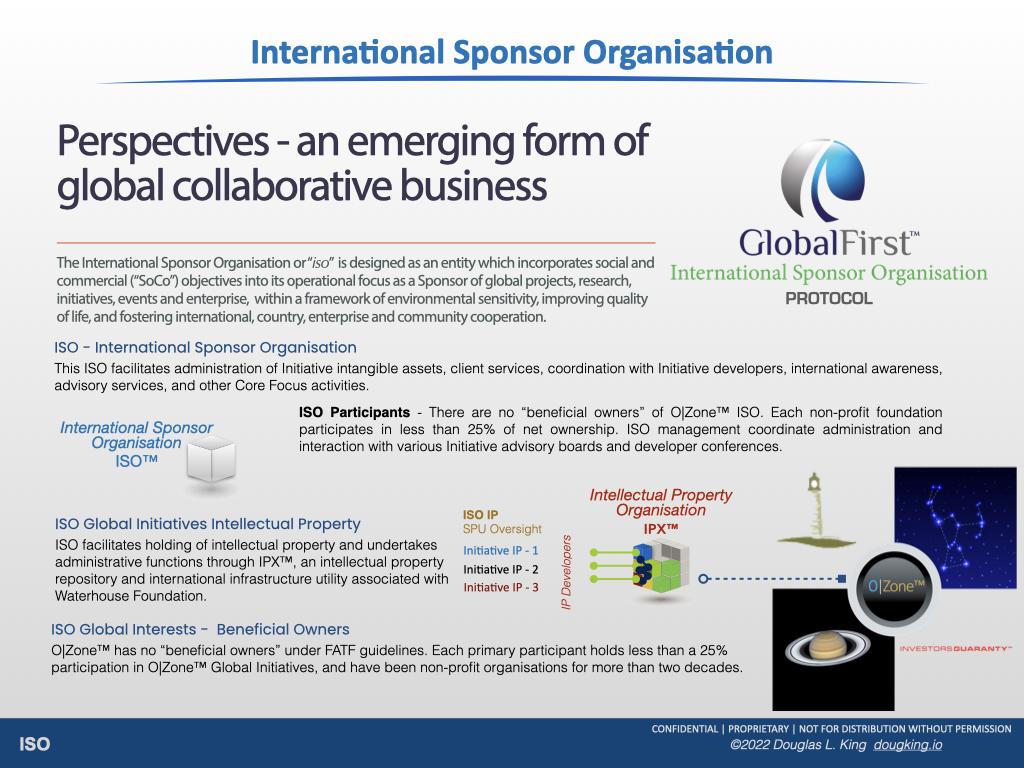
An ECOSYSTEM ISO is an International Sponsor Organisation coordinating development and implementation of an ECOSYSTEM Protocol.
An iso operates globally as an active Sponsor, Developer, Operator and Promoter of its Core Focus activities, coordinating through its management, International Advisory Board, Member Association, DAOs and Core Focus members, supporting its clients, affiliations and communities.
ISO founders sponsor Alliance iii.o components which comprise the gateways and interconnects of ECOSYSTEM mesh network nodes on which the DAO(s) portion of the Protocol operates including its digital controllable electronic records.


An ISO is owned by non-profit charitable | educational foundations, with no foundation holding 25% of more, thus no beneficial owners.
Its International Advisory Board, Member Association and DAOs assist in development, technical expertise, governance, collaboration and global awareness.
The Board of Directors and other governance bodies may be structured to fit the Protocol.
Revenue above expenses is distributed to Foundations.
In establishing an Ecosystem, various Components and other elements of an Ecosystem are brought together to create the operational and administrative framework of such Ecosystem.
In assembling Components, an ISO represents an "accredited party", particularly in the process of "sponsoring" a regulatory component.
Participants in a Sponsor ("Sponsor Group") of an Ecosystem, whose activities are administered through an ISO, may benefit from a range of Ecosystem activities, with a portion of such benefits being allocated to Ecosystem Society members, core Foundations and other participants as described herein, including intellectual property participants.
The schematic illustrates an ISO for O|Zone™ Initiatives. O|Zone™ provides a framework for geographic and Community centric Initiatives developed by AD&C Principals.
International Sponsor Organization (ISO) is the foundational Sponsor Entity formed under the Alliance iii.o Protocol, created to serve as the jurisdictional, operational, and digital anchor for the global emergence of an Initiative and its Ecosystems.
Structured as a Segregated Portfolio Company (SPC) domiciled in the Cayman Islands, the ISO is owned by five independent nonprofit foundations, each holding under 25% ownership. This design ensures that the ISO qualifies as a non–beneficial owner under international transparency and anti-money laundering regulations, while maintaining jurisdictional stability, legal neutrality, and modular extensibility.
The ISO serves three essential purposes:
Sponsor of the Initiative – It is the legal and operational anchor of the Initiative itself, not merely its components.
Facilitator of Ecosystem Formation – Through Segregated Portfolio Units (SPUs), the ISO supports the creation of modular Ecosystems aligned to specific regions, jurisdictions, or thematic areas. For example, an SPU might facilitate national activities through a local legal structure (e.g., a U.S.-based 501(c)(4)), while maintaining connection to the ISO at the Homeworld level.
Global Interface for HUMAN Participation – The ISO provides a neutral gateway for HUMANs, organizations, and DAOs to participate in the Initiative through digitally anchored, jurisdictionally sound channels as a part of the ISO's Society.
DAO structures aligned to the ISO enable:
Participation by individuals and entities from multiple disciplines and geographies within the Society.
Secure and transparent data flow, monetary flow, and expense reimbursement
Deployment of working groups, conferences, endowed chairs, and collaborative research programs
The ISO is designed to scale internationally, with modularity that allows it to support Ecosystems across multiple Ecosystems. Through its structure, it fosters a globally inclusive environment for sovereign, creative, and collaborative engagement—built for longevity, compliance, and human-centric integration, including with myriad HUMANs, ORGANISATIONS, and INTELLIGENCES.